Tsinghua University
I am a master's student in Software Engineering at Tsinghua University, expected to graduate in 2027. I also received my B.Eng. in Software Engineering from Tsinghua University.
My research and engineering work focuses on LLM post-training and retrieval augmentation, including Agentic RAG, SFT/GRPO, model evaluation and error analysis, and distributed training-system optimization.
During internships at Alibaba Qwen and Kuaishou, I worked on long-horizon Agentic RAG, LLM post-training, multimodal recommendation representations, and generative recommendation, with an emphasis on building accurate, reliable, and efficient LLM systems.
Education
-
 Tsinghua UniversitySchool of SoftwareM.S. in Software EngineeringAug. 2024 - Jun. 2027 (expected)
 -
Tsinghua UniversitySchool of SoftwareB.Eng. in Software EngineeringSep. 2020 - Jun. 2024
Experience
-
Tsinghua UniversityGraduate Student AssociationLead, Information Service Center2024 - 2025
Honors & Awards
-
Tsinghua Outstanding Student Cadre2025
-
Comprehensive Excellence Scholarship2024-2025
-
Technology Innovation Scholarship2023
-
Academic Excellence Scholarship2021-2022
-
Tsinghua Challenge Cup, Third Prize2023
Internship Experience
Alibaba | Qwen | LLM Algorithm Intern
Jun. 2026 - Aug. 2026- Long-horizon Agentic RAG for complex knowledge questions: Addressed fragmented criteria and misleading evidence in single-pass RAG. Responsible for POC validation and solution development; redesigned the pipeline as an agent that autonomously searches, verifies evidence, and stops, and designed a Source-Aware Agent Loop for tool calls, evidence conflicts, and stopping. On Qwen3.6-35B-A3B, accuracy improved from 85.23% to 89.26% (+4.03pp).
- Agent post-training, evaluation, and continuous iteration: Diagnosed tool-behavior collapse caused by direct RL and restored tool use with SFT on teacher trajectories. For sparse GRPO signals, built a loop of closed-book screening, multi-angle rollout stratification, failure attribution, and question synthesis, with continuous evaluation across correctness, tool behavior, latency, and bad cases. Final accuracy reached 91.95%, while agent latency decreased from 19.49s to 12.23s.
- Heterogeneous RL training optimization: Modified the verl fully-async pipeline for the different workloads of policy updates and rollouts, with L20X/H20 device pools and direct NCCL weight transfer. On 32 GPUs (2+2 nodes), average step time decreased from 280s to 116s, improving throughput by 2.41×.
Kuaishou | Foundation Models & Applications | LLM Algorithm Intern
Jan. 2026 - Jun. 2026- Multimodal recommendation representations (CREM; Excellent Launch Review): Upgraded the CREM backbone from Qwen2.5-VL-3B to Qwen2.5-Omni-3B and added audio for livestream scenarios. Generated tens of millions of LLM relevance soft labels and combined popularity-aware negative sampling, in-batch hard-negative mining, InfoNCE, and multimodal QA co-training for recommendation-domain alignment. Responsible for the data pipeline, distributed training and inference, and delivery of the online embedding service; achieved +0.45pp offline AUC and +1.883% on the posterior expected-spend metric.
- Unified generative recommendation and user modeling (UBioRec): Built 600K triplets for multi-task SFT on Qwen2.5-7B. Used an Adaptive Token Scheme and shared-prefix KV cache to unify item prediction and user-profile generation, accelerating profile inference by 6.5×; achieved NDCG=0.2098 in 10K-scale retrieval, +2.29% local-life GMV, and +0.91% watch time in zero-shot transfer to the following feed.
News
Selected Publications & Manuscripts (view all )
SoBR: Scaling Annotation-Free Code Retriever Training Beyond the Memory Wall
Chenghao Zhang, et al.
AAAI Conference on Artificial Intelligence (AAAI), under review 2027 (first author)
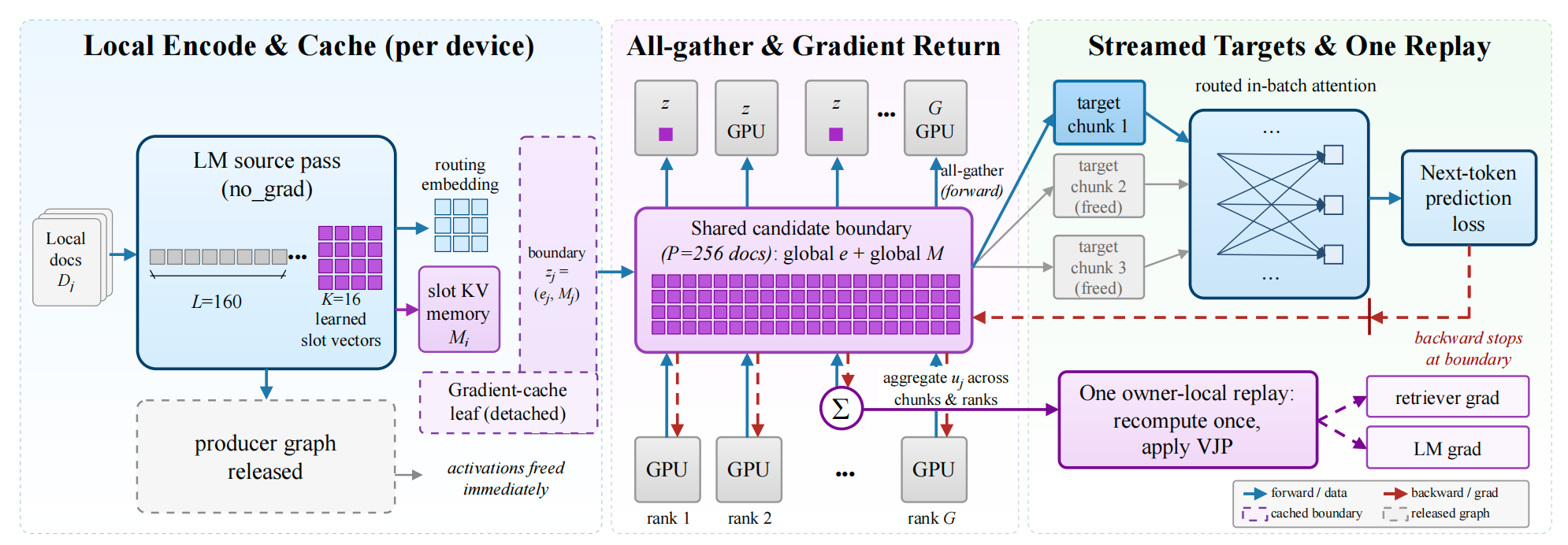
Introduces Source Slots to compress candidate representations for annotation-free retriever training, together with a single replay after cross-device gradient aggregation to preserve full-batch gradient equivalence while releasing intermediate activations. The method scales training to an 8B retriever with a shared pool of 256 documents and reaches 4.5× the median training speed of activation checkpointing.
SoBR: Scaling Annotation-Free Code Retriever Training Beyond the Memory Wall
Chenghao Zhang, et al.
AAAI Conference on Artificial Intelligence (AAAI), under review 2027 (first author)
Introduces Source Slots to compress candidate representations for annotation-free retriever training, together with a single replay after cross-device gradient aggregation to preserve full-batch gradient equivalence while releasing intermediate activations. The method scales training to an 8B retriever with a shared pool of 256 documents and reaches 4.5× the median training speed of activation checkpointing.
ClaimWeaver: Query-Conditioned Evidence Organization for Multi-Hop Retrieval-Augmented Generation
Chenghao Zhang, et al.
AAAI Conference on Artificial Intelligence (AAAI), under review 2027 (co-first author)
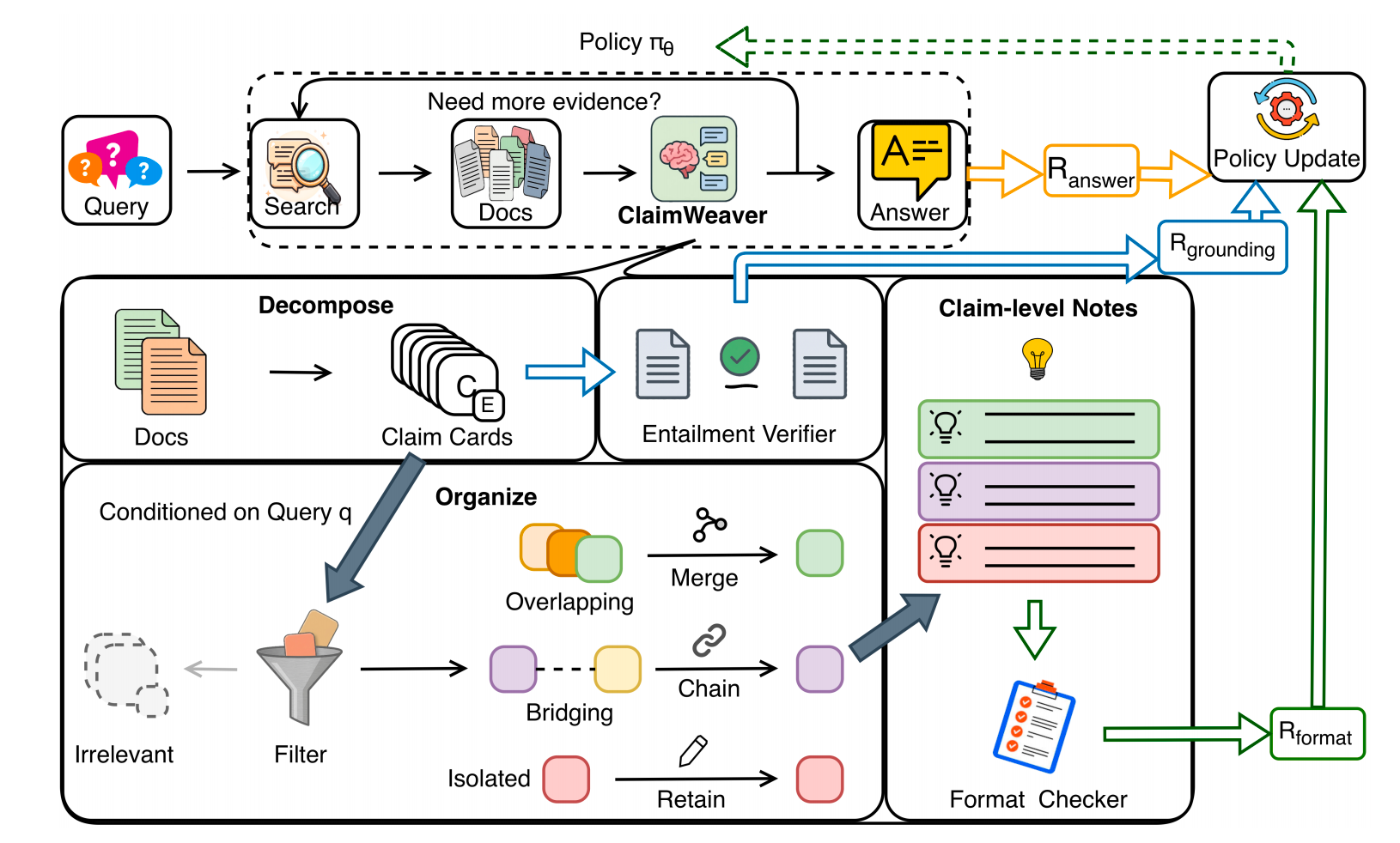
Introduces ClaimWeaver, a query-conditioned evidence organization framework that decomposes retrieved passages into source-grounded atomic claims, filters and consolidates evidence, and connects complementary claims through directed bridges for multi-hop reasoning.
ClaimWeaver: Query-Conditioned Evidence Organization for Multi-Hop Retrieval-Augmented Generation
Chenghao Zhang, et al.
AAAI Conference on Artificial Intelligence (AAAI), under review 2027 (co-first author)
Introduces ClaimWeaver, a query-conditioned evidence organization framework that decomposes retrieved passages into source-grounded atomic claims, filters and consolidates evidence, and connects complementary claims through directed bridges for multi-hop reasoning.
Disentangled Generation-Based Prototypical Alignment for Few-Shot Unsupervised Domain Adaptation in Graph-Level Anomaly Detection
Z. Ni, Chenghao Zhang, H. Wan, X. Zhao
AAAI Conference on Artificial Intelligence (AAAI) 2026
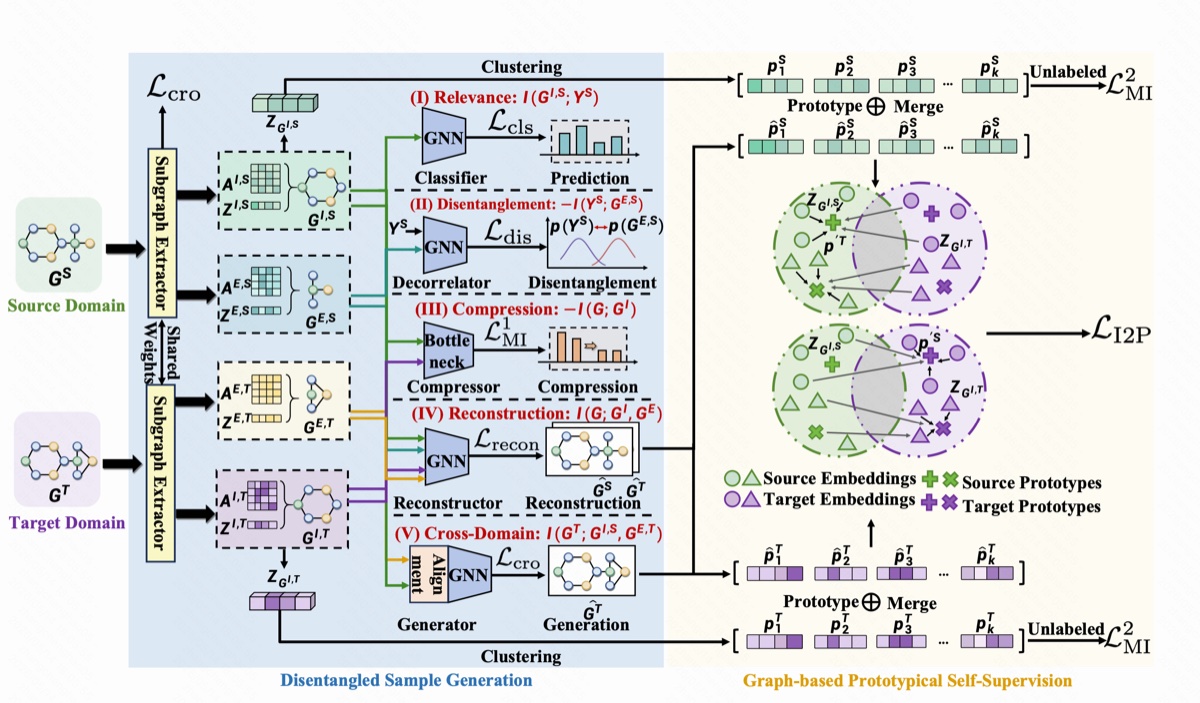
Introduces DGPA to mitigate performance degradation in cross-domain few-shot graph-level anomaly detection, improving average AUROC by 5.72pp over the strongest baseline.
Disentangled Generation-Based Prototypical Alignment for Few-Shot Unsupervised Domain Adaptation in Graph-Level Anomaly Detection
Z. Ni, Chenghao Zhang, H. Wan, X. Zhao
AAAI Conference on Artificial Intelligence (AAAI) 2026
Introduces DGPA to mitigate performance degradation in cross-domain few-shot graph-level anomaly detection, improving average AUROC by 5.72pp over the strongest baseline.
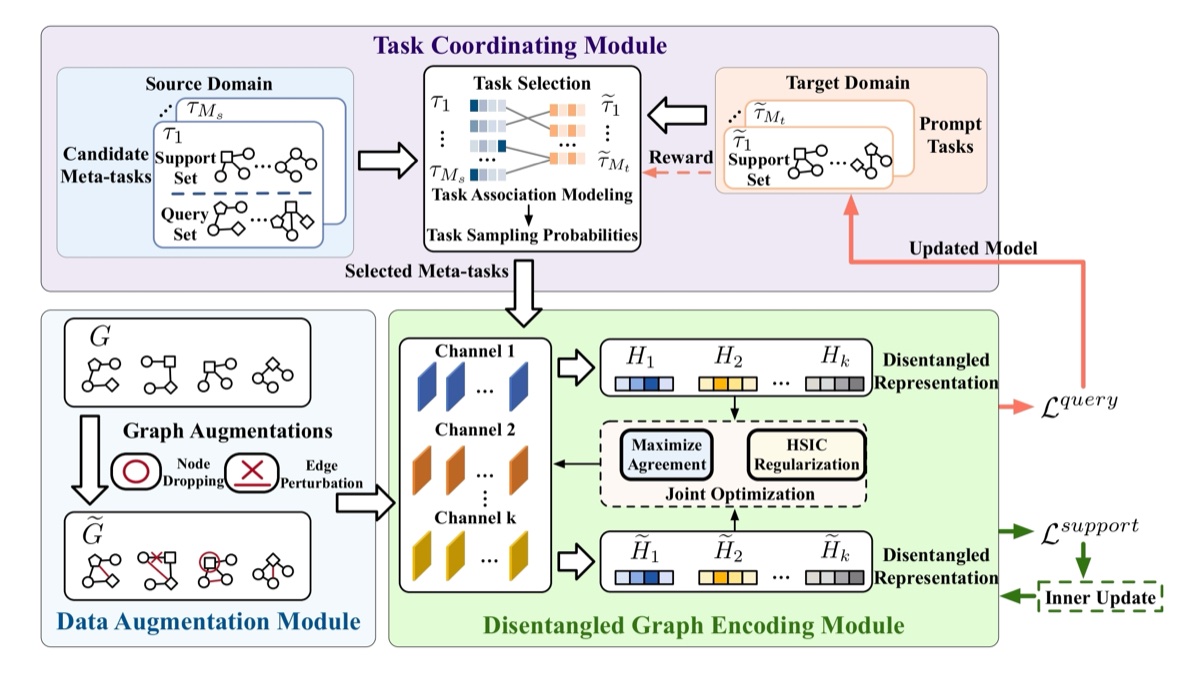
Factor-wise Disentangled Contrastive Learning for Cross-domain Few-shot Molecular Property Prediction
Z. Ni, Chenghao Zhang, H. Wan, X. Zhao
Frontiers of Computer Science 2025
Studies factor-wise disentangled contrastive learning for cross-domain few-shot molecular property prediction and improves average ROC-AUC by 1.53pp.
Factor-wise Disentangled Contrastive Learning for Cross-domain Few-shot Molecular Property Prediction
Z. Ni, Chenghao Zhang, H. Wan, X. Zhao
Frontiers of Computer Science 2025
Studies factor-wise disentangled contrastive learning for cross-domain few-shot molecular property prediction and improves average ROC-AUC by 1.53pp.
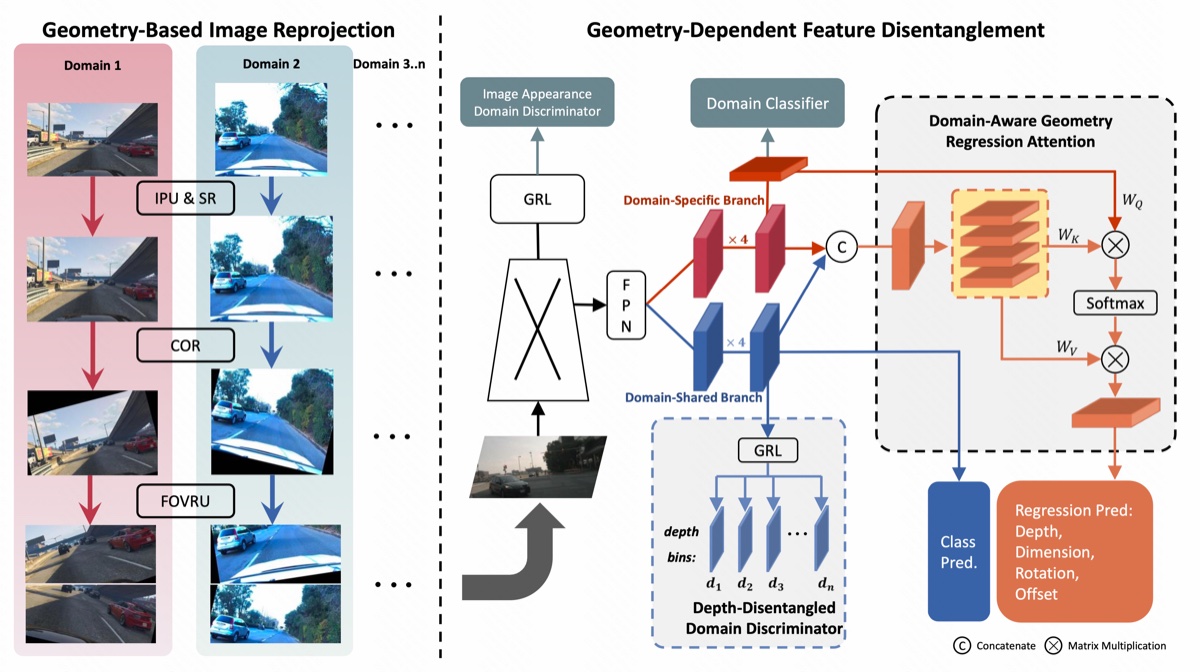
Geometry-Guided Domain Generalization for Monocular 3D Object Detection
F. Yang, H. Chen, Y. He, S. Zhao, Chenghao Zhang, K. Ni, G. Ding
AAAI Conference on Artificial Intelligence (AAAI) 2024
Uses geometry priors to improve cross-domain generalization for monocular 3D object detection. I contributed to implementing and integrating the attention module.
Geometry-Guided Domain Generalization for Monocular 3D Object Detection
F. Yang, H. Chen, Y. He, S. Zhao, Chenghao Zhang, K. Ni, G. Ding
AAAI Conference on Artificial Intelligence (AAAI) 2024
Uses geometry priors to improve cross-domain generalization for monocular 3D object detection. I contributed to implementing and integrating the attention module.
All publications
Research Focus
Agentic RAG
Building long-horizon agents that search, verify evidence, resolve conflicts, and stop appropriately for complex knowledge tasks.
LLM Post-Training
Improving model capabilities and tool use through SFT/GRPO, trajectory construction, reward design, model evaluation, and error analysis.
Retrieval & Recommendation
Learning multimodal recommendation representations and generative user/item models with contrastive and multi-task objectives.
Distributed Training Optimization
Optimizing distributed training, asynchronous RL pipelines, rollout serving, communication, latency, and throughput for efficient LLM development.